
The Omega Framework:
Measuring the Forces That Elevate Collective Human Performance and Experience
What Is Omega?
Omega (Ω) is the name I’ve given to something every high-performing family, team, organization or community has felt but few have been able to measure or replicate: that sense of working together with uncommon coherence, where effort compounds rather than dissipates, and challenges that would overwhelm individuals become manageable for the collective.
Omega operates in human systems the way gravity, magnetism, or an attractive force operates in physical systems. It's the binding force that counteracts entropy—the natural drift toward fragmentation, confusion, and misalignment that is present in any human system. Omega channels energy and attention toward shared outcomes rather than allowing it to dissipate as a group pulls apart.
Groups with high Omega consistently describe these environments as their most meaningful collaborative experiences. Groups with low Omega report frustration, exhaustion, and diminishing returns—even when talented and well-intentioned people are involved.
The Omega Framework provides both language and measurement for this phenomenon.
Why Omega Matters: The Law of Collective Conservation
In any human system, available energy is finite. The critical question is: where does that energy go?
Available Energy = Productive Work + Corrective Effort
- Productive Work: Creating value, achieving goals, serving customers, designing solutions, delivering results
- Corrective Effort: Clarifying role confusion, clearing up miscommunications, resolving conflicts, managing around dysfunction
Consider group work as a “performance loop” cycle of collective thought, behavior, and emotion. The model below illustrates how collective force (Ω) shapes the tightness of performance loops and determines how energy is conserved or lost within a human system.
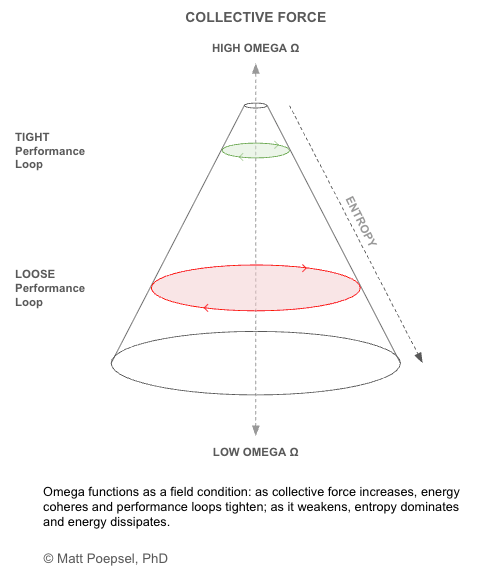
When Omega is strong, performance loops tighten. Teams sense, decide, and act in rapid alignment. A greater percentage of available energy flows toward productive work because less is consumed by correction and repair.
When Omega weakens, performance loops loosen. The same talented people, working the same hours, produce diminishing results as entropy increases and more energy dissipates through friction, misalignment, and rework.
Omega doesn't eliminate tension, it metabolizes it. Omega allows systems to absorb complexity without fragmenting.
The Four Constituent Forces of Omega
Omega emerges from the interaction of four measurable dimensions. These forces don't operate independently—they reinforce each other, creating nonlinear effects where small improvements in one area can dramatically elevate overall system performance.
Hope
Shared belief that collective effort leads to meaningful outcomes. Hope provides directional energy, anchoring work to a credible vision of where the team is headed. Without Hope, systems conserve energy defensively rather than invest it generatively.
Mutuality
Interdependence where success and failure are experienced collectively rather than individually. Mutuality establishes shared stakes and preserves trust, transforming coordination from self-interest and self-preservation into genuine cooperation.
Synchrony
Alignment of timing, attention, and action across the system. Synchrony reduces drag caused by misaligned priorities and rhythms, allowing teams to move faster without rushing because effort is properly sequenced and applied rather than compressed and squandered.
Commitment
Sustained reliability that stabilizes coherence in the face of uncertainty, fatigue, and adversity. Commitment deepens intent and dependability, increasing group members’ willingness to invest in the group’s performance and its work product and allowing it to sustain performance under pressure.
How Omega Manifests: Three Dimensions of Collective Experience
Teams experiencing high Omega describe it across three interconnected domains:
Structurally as interdependence, where roles, responsibilities, and workflows are mutually enabling rather than isolating. Work naturally reinforces rather than conflicts.
Socially as esprit de corps, a shared emotional bond that sustains effort beyond transactional motivation. Personal identity expands to include collective success.
Spiritually as collective consciousness, a shared awareness of purpose, unity, and moral responsibility that allows groups to act with coherence even without explicit instruction.
Tight Loops: The Operational Signature of Omega
When Omega is present, it manifests operationally as Tight Loops—rapid, trusted performance cycles where sensing, decision-making, and action are closely coupled.
Tight loops preserve energy by minimizing redundancy, defensive behavior, and compensatory controls. They indicate that the system is learning and adapting efficiently rather than grinding through repeated correction cycles.
Tight Loops describe what works in human systems. Omega explains why it works.
Measurement & Research
The Omega Assessment is a prototype 20-item psychometric instrument measuring Hope, Mutuality, Synchrony, and Commitment across teams and organizations. Early research consistently shows that high Omega scores correlate with teams' most positive collaborative experiences and superior performance outcomes.
This research is being conducted in partnership with Boston College to establish a rigorous scientific foundation for understanding and cultivating the conditions that allow human systems to transcend their individual limitations.
Early findings:
- High Omega scores consistently correlate with positive work experiences across different organizational contexts
- The four constituent forces (Hope, Mutuality, Synchrony, Commitment) appear to vary independently, suggesting they capture distinct dimensions of collective experience
- Individual respondents show significant variation in Omega across different group environments, indicating Omega is a property of the system rather than the individual
Leadership Implications
Omega cannot be mandated, installed, or coerced. It emerges when underlying conditions support it. Leadership is essential in cultivating these conditions.
Leadership in High Omega systems is fundamentally about field stewardship—establishing and protecting tight loops, preserving collective interest and execution, and removing sources of unnecessary entropy. Effective leaders shift attention from managing individual performance to cultivating collective conditions.
The leader's role becomes identifying where Hope, Mutuality, Synchrony, or Commitment are weakening, and strengthening those specific forces before system-wide fragmentation accelerates. Ever-present entropy threatens to create distance between group constituents.
Through the lens of Omega, a foundational truth emerges: leaders are healers of separation.
The Path Forward
In an era where AI is rapidly consuming cognitive tasks once considered distinctly human, our future value increasingly lies in our capacity to coordinate, cohere, and create together. Omega represents humanity's unassailable advantage—the ability to bind ourselves in systems that cannot be reduced to mechanical components or logics. We can create and preserve higher-order human systems that are greater than the sum of individual capabilities.
Understanding and strengthening Omega isn't just about organizational performance. It's about healing the fragmentation affecting families, communities, organizations, and society itself. It's about relearning how to work together in ways that actualize energy rather than deplete it.
Omega is the foundational science. Its application is Tight Loops →
Research Partnership
This work is being conducted in partnership with Boston College. For research collaboration inquiries, assessment access, or organizational partnerships, please contact me.