
Your organization is working harder than it should have to.
Tight Loops™ explains why and what to do about it.
Not another framework. A lens for seeing the company you already run in a new light.
You've felt it.
The company grows. You hire good people. You add better tools, clearer processes, more experience.
And somehow, everything takes more effort than it used to.
The story your twentieth employee tells about the work is not the story your hundredth employee tells. Your exec team, your managers, and your front line experience three different companies. A decision you made in March gets quietly unmade in June. Somewhere along the way you stopped knowing everyone's name, and you're not sure what that cost you.
You're also the one person in the building who feels the full weight of it. Everyone else can leave. You're the one carrying real risk.
If that sounds familiar, you're not alone and you're not to blame.
It also doesn't mean you have the wrong people, the wrong strategy, or the wrong operating system.
It means your organization is doing what growing organizations do:
Drifting apart.
As a company grows, people and work pull apart. More energy goes into re-explaining, re-deciding, and re-aligning. Leaders describe it as running two jobs at once: the business itself and the constant work of keeping everyone pointed the same way.
That lost energy shows up as friction. It's the tax of drift.
But drift can be reversed.
When people draw together, work moves faster and costs less to move. Same company, same people, same market but less effort spent going sideways.
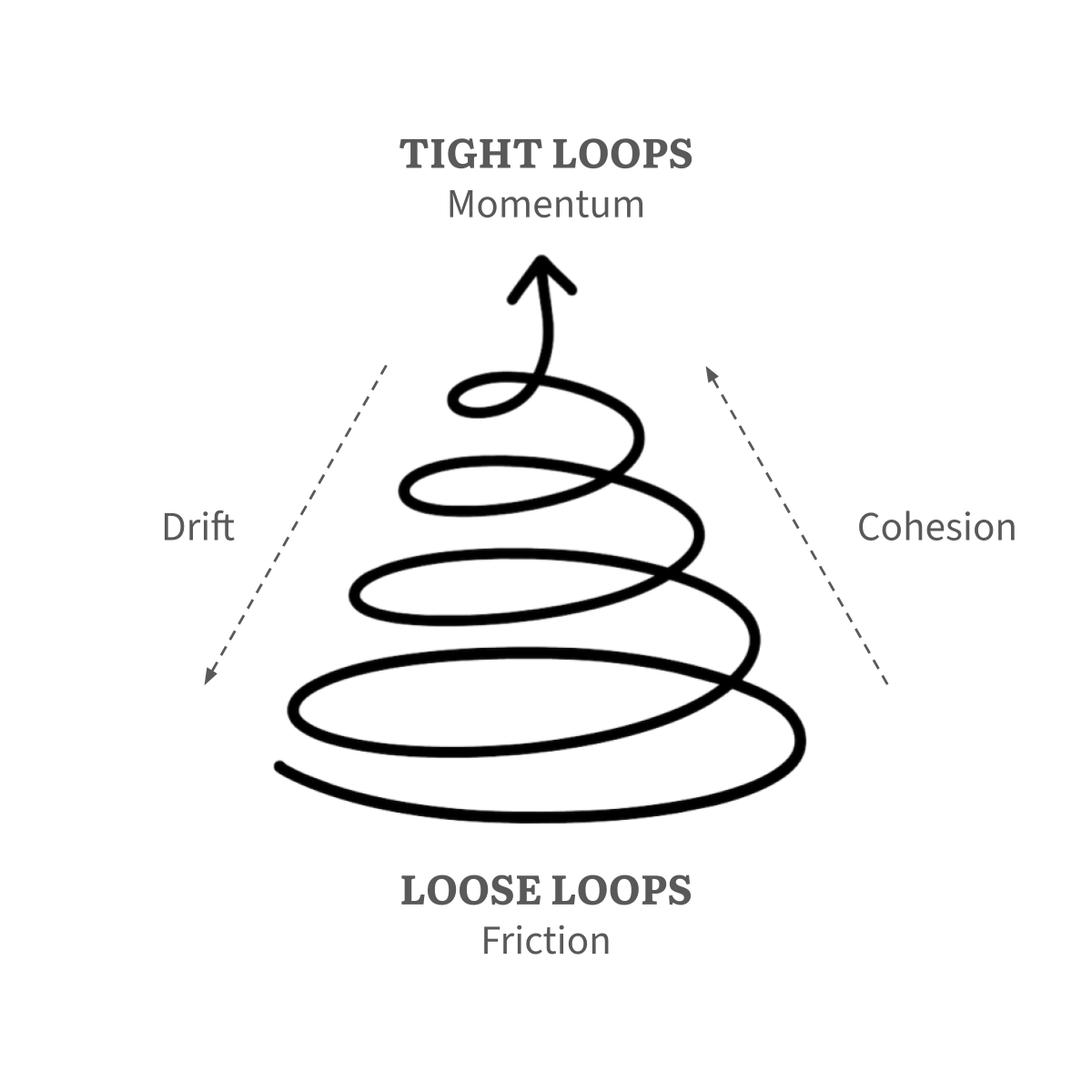
Tight Loops explains the mechanics underneath the problems you're trying to solve.
How to read the diagram:
The spiral is your organization doing its work, one rotation after another. The width of each coil is the distance between your people as they do it. Think of a bucket brigade. When people stand near one another, the water passes quickly and very little spills. When they spread out, every pass costs more.
At the bottom, the coils are wide. These are Loose Loops. Every rotation covers more ground and burns more effort. This is due to friction.
At the top, the coils draw inward. These are Tight Loops. Each rotation takes less effort to complete. That creates momentum.
Two forces determine which direction you travel. Drift, on the left, pulls the coils open. It's the default due to entropy working inside a human system. Worse yet, growth and complexity accelerate it. Cohesion, on the right, draws the coils back in. It's the counterforce, and it's the thing that moves you up the spiral toward Tight Loops.
No organization occupies a fixed position on this diagram. Right now, your teams are either tightening or loosening, and by extension, so is your organization.
Once you see it, a lot of familiar problems start to look different.
The slow decisions. The competing priorities. The resistance to change. The handoff that keeps breaking down. The initiative that somehow requires twice the effort it should.
They may look like separate problems.
Often they're symptoms of the same thing: the organization is drifting apart faster than its leaders are pulling it together.
Which is the good news hidden inside the problem because leaders can change the balance.
Drift isn't anyone's fault, but reversing it is somebody's job. In most companies, that job belongs to the person who can see the whole system.
As the company changes, the way you lead it has to change with it.
You don't need to replace your operating system. You don't need another layer of meetings. You don't need an off-site, a six-month rollout, or a wholesale reinvention of your company.
You can keep doing the work you're already doing.
But you must learn to see where energy is leaking out of the system and make small, deliberate adjustments that tighten the loops.
Organizations drift apart.
Drift is the default.
Cohesion reverses drift.
Tight Loops conserve energy.
If you want to go faster, grow bigger, and flow better, you have to tighten the loops.
Frequently Asked Questions
How is this different from the frameworks I already use?
Frameworks help you organize what you're seeing. Tight Loops explains why it's happening.
If you run EOS, keep running EOS. Same for Traction, OKRs, the Scaling Up disciplines, or the operating rhythm you built yourself. Those tell you what to work on and how to keep score.
Tight Loops sits underneath whatever you already use. It helps explain why a system that worked at forty people starts grinding at a hundred and forty.
It's a lens, not a replacement.
Is this actually researched, or is it just a metaphor?
It's researched, and the research is ongoing.
Tight Loops is the applied side of the Center for Organizational Drift, which conducts PhD-led research into how and why organizations come apart as they grow.
The Center's evidence base draws from three directions: structured interviews with CEOs who have scaled companies, direct measurement of cohesion and corrective effort inside real organizations, and credible secondary research from adjacent fields.
The work is early and the Center publishes as it goes. What you're seeing is a live body of research, not a finished one.
Does this apply to a company like mine?
Almost certainly, because it isn't about industry.
Drift operates anywhere people have to coordinate toward something. It shows up on a six-person leadership team and across a three-thousand-person company. What changes is the intensity.
One threshold keeps surfacing in the Center's interviews: somewhere around a hundred employees, a CEO stops knowing everyone by name. Relationships that used to run through the CEO now have to run through something else.
What that something else is determines how much energy the company loses from there on.
Can you actually measure this?
Yes. That's the part most leaders don't expect.
CEOs describe the cost in their own way: running two jobs, spending exhausting amounts of effort just keeping people pointed in the same direction.
That's corrective effort: the energy going into re-explaining, re-deciding, re-aligning, and repairing work that should have flowed the first time. I measure how much of it people are experiencing and where it's showing up.
The Omega (Ω) assessment measures cohesion across four forces and corrective effort across ten dimensions, surfacing the specific gaps pulling a group apart.
Together, the measures make something usually subjective more visible: how much energy your organization is losing, where it's being lost, and how strongly the group is holding together.
How does Tight Loops stay current?
It's fed by research from the Center.
As the Center for Organizational Drift surfaces new findings about how organizations come apart, new Tight Loops applications reveal how to pull them back together.
The research side keeps studying the problem. The applied side keeps sharpening the response.
Considering the current rate of disruption, neither will be finished anytime soon.
Seeing drift is the first step.
If you think your company is leaking energy due to drift, the next move is to find out where it's actually going. That starts with measurement.